Zakat al-Fitr for one person
Zakat al-Fitr for three people
Zakat al-Fitr for five people
Enter Amount
Zakat al-Fitr is $10 per person
Your fast is a journey; this is the final step. Complete your fast by providing for others. It only takes a moment to secure your Zakat al-Fitr for yourself and your family.
For those of you offering Salat al-Eid, or Eid prayer, at home, we’ve put together a step-by-step guide to help guide you.
Why is Salat al-Eid prayed?
Salat al-Eid is considered either a sunnah, wajib (required) or fard kifaya (communal obligation) act of worship, depending on the madhab you follow.
How to prepare
On the morning of Eid, it’s sunnah to take a shower (i.e. perform ghusl) before you settle down to pray. It is also sunnah to start the day by eating dates before you’ve prayed.
When to pray
Eid prayer must be performed after the sun has risen. As a result, you cannot pray the Eid prayer immediately after Fajr. Also, Eid prayer must be performed before zawaal. Zawaal refers to the time in which the sun has reached zenith, its highest point in the sky. Therefore, our recommendation is to perform the Eid prayer anytime between the hours of 7 am and 12 pm.
There is no khutbah (sermon) after the prayer if you pray at home. However, you can listen to an online sermon, which is considered mandub (recommended).
Whether it’s your first time praying at home or you need a quick refresher,
use this step-by-step guide to prepare for a blessed Eid celebration.
Perform prayer between 7:00 AM and 12:00 PM (after sunrise but before Zawaal).
Perform Ghusl (ritual shower) before prayer and dress in your best clothes.
It is Sunnah to eat an odd number of dates before heading to prayer.
Key Differences: No Adhan, No Iqama, and extra Takbeerat (Allahu Akbar).
How it’s prayed
Unique elements of Eid prayer:
2. Say the takbeer three times before beginning to recite from the Qur’an.
3. Recite Surah Al-Fatiha followed by another surah. The sunnah is Surah Al-Alaa and Surah Ghashiya or Surah Qaf and Surah Qamar for first and second rakas, respectively.
4. Perform rukuu and two sajdas as normal. This concludes the first rakah.
5. After you come up from sujood from the first rakah, you recite Surah Al-Fatiha followed by another surah.
6. After the surah, say the takbeer 3 times, then 1 additional takbeer to go to rukuu.
7. After rukuu, you continue with two sajdas and the final sitting as normal to conclude the prayer.
1. Begin with takbeerat al-ihram to open the prayer, then six additional takbeer. The sunnah is to pause at this point for people behind you to repeat after you.
2. Recite Surah Al-Fatiha followed by another surah.
3. Make rukuu, sujood, and come up from the first rakah saying 1 takbeer, as normal.
4. Say 5 additional takbeerat before continuing on through your second rakah as normal.
1. Begin with seven takbeerat and then Quran recitation, rukuu, and sujood, as normal.
2. When you get up from the first rakah saying 1 takbeer, then do 5 additional takbeerat.
3. Continue on through the second rakah as normal.
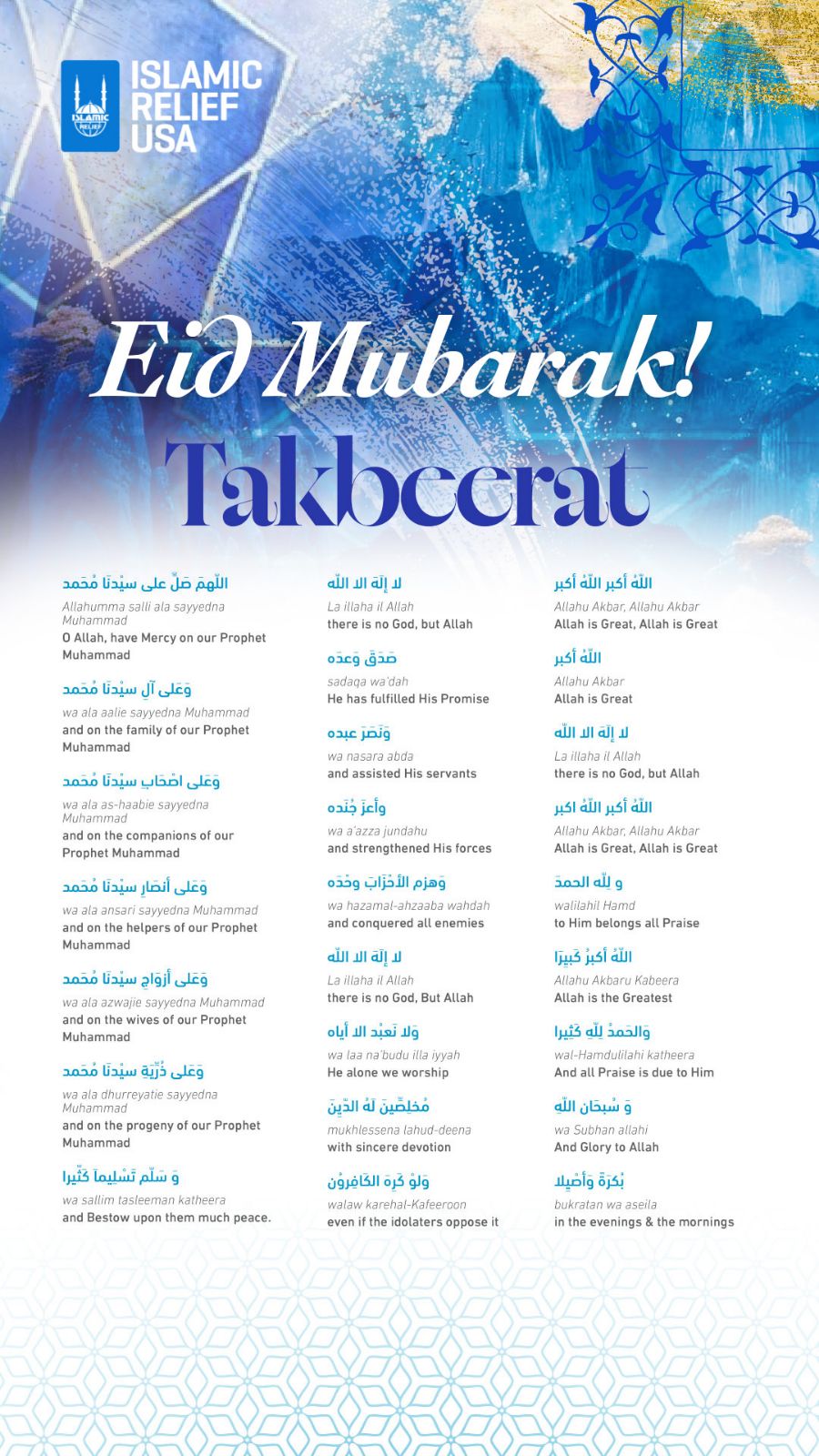
Takbeer in Eid Al-Fitr starts right after sun set on the night before Eid and continues till the Imam starts Eid prayer.
On Eid Al-Adha, Takbeer starts from the beginning of the month of Dhul-Hijjah till the last day of Tashreeq (the days of Tashreeq are the 3 days following the day of Eid Al-Adha).
Click and save the graphic below!